
Power and Free Conveyors
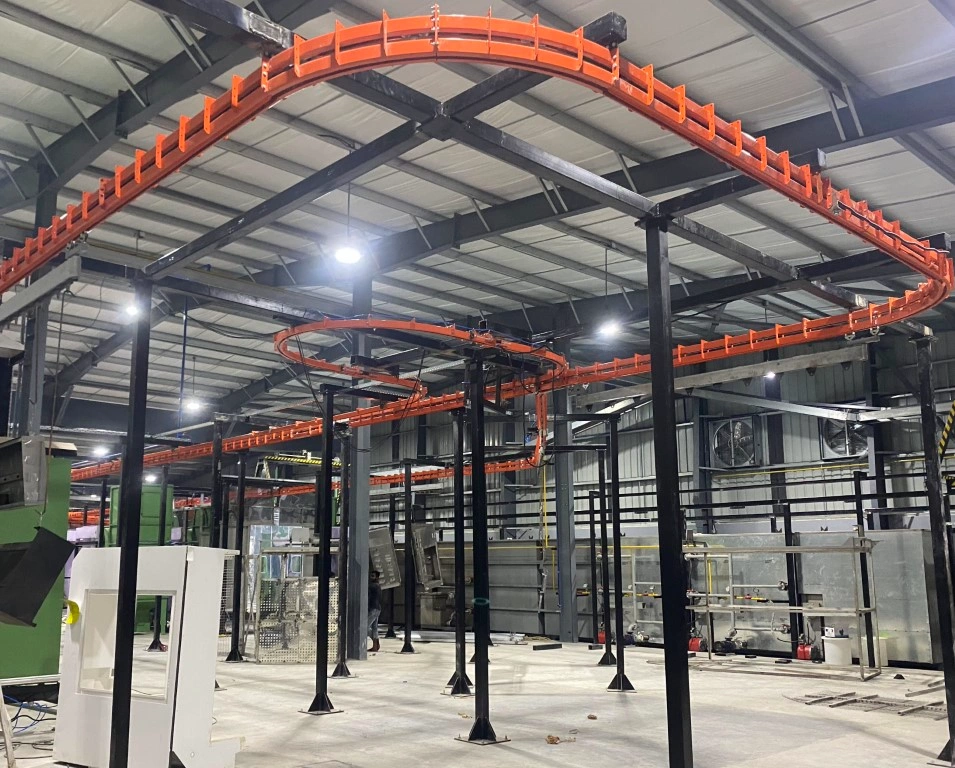
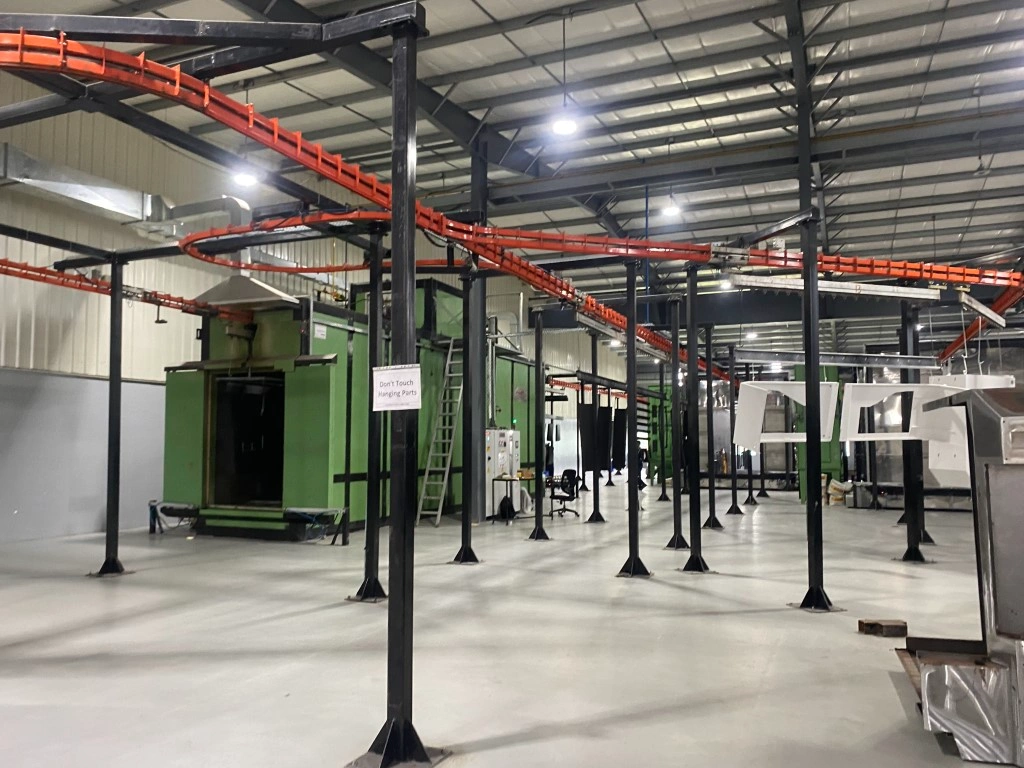
If enclosed track conveyors are the agile standard and I-beam conveyors are the heavy-duty workhorses, Power and Free conveyors are the ultimate “intelligent brains” of high-volume finishing plants.
Traditional overhead conveyors are continuous loops: if you stop the chain to load a part, the entire line stops. A Power and Free system solves this problem entirely, allowing parts to stop, start, accumulate, and switch tracks independently while the main drive chain keeps moving.
How It Works: The Dual-Track System
* The Upper Track (“Power”): Houses a continuously moving conveyor chain equipped with pusher dogs (mechanical hooks) pointing downward.
* The Lower Track (“Free”): Houses independent, unpowered trolleys from which the workpieces hang.
When a part needs to move, a mechanical dog from the upper power chain engages with a retractable flipper on the lower free trolley, pushing it along. If you need to stop the part—say, inside a powder spray booth—a mechanical stop drops down, depressing the flipper. The power chain instantly disengages and passes harmlessly overhead, leaving the part safely stationary while the rest of the line continues to move.
Why They Are the Gold Standard for Paint Shops
High-efficiency paint and powder coating shops thrive on Power and Free systems because they decouple conflicting process timelines:
-
Close-Pack Accumulation (In-Line Buffering)
Different stages of finishing require radically different timeframes. A chemical wash might take 3 minutes, a powder booth might take 1 minute, but a baking oven might require 25 minutes.
Power and Free conveyors can shift trolleys into a "close-pack" configuration—grouping parts tightly together side-by-side inside the curing oven or storage buffers, and then spreading them back out when entering the spray booth. This dramatically saves floor space and oven energy. -
Variable Speeds Across Different Zones
Because parts can disengage from one power loop and engage with another, a single part can travel at a fast pace through empty warehouse space, slow down to a crawl inside a liquid paint booth for precision robotic application, and then stop completely in a flash-off zone.
-
Dynamic Routing and Track Switching
Not every part requires the same treatment. If you have a line running both steel and aluminum parts, a Power and Free system can read a part's barcode or RFID tag and automatically route the steel parts to a 5-stage zinc-phosphate wash, while bypassing that step for the aluminum parts. Parts can also be rerouted to a "reject/touch-up" loop without disrupting the main production line.
When to Choose Power and Free
Implementing a Power and Free system requires a substantial upfront capital investment and an experienced automation controls team. It is ideal if your plant:
-
Processes a high volume of highly mixed parts with varying recipe times.
-
Requires manual loading/unloading or precision robotic painting that necessitates stationary parts.
-
Is space-constrained and needs to maximize density inside curing ovens.
For mass-production operations—like automotive paint shops, heavy industrial machinery lines, and Tier-1 appliance suppliers—the massive boost in throughput and reduction in finish defects easily justifies the initial investment.